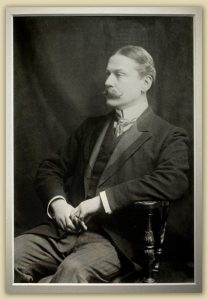
 Pseudonym of Jozua Marius Willem (Joost) Schwartz, since April 9, 1889 van der Poorten Schwartz, Dutch/English prose writer and poet (Amsterdam 15.8.1858 – Doorn 3.8.1915). During his youth, Maartens spent a period of six years (1864 – 1870) in London, where his father (born Solomon Schwartz in Meseritz, Prussian-Polish, in 1817 ) was initially destined to become a rabbi. However, he converted to Christianity and was renamed August Ferdinand Carl Schwartz. He became a pastor, with the special assignment of carrying out missions among London Jews. Earlier, from 1849 to 1864, Schwartz had served with the same assignment among the Jewish population of Amsterdam. Shortly after his arrival in Amsterdam, Carl Schwartz married Cornelia van Vollenhoven (1822-1902), scion of a prominent Amsterdam family. After the death (1870) of his father, Joost Schwartz attended grammar school initially in Amsterdam, later in Bonn where he graduated. He went to study law in Utrecht in 1877, where he obtained his doctorate in 1882. Shortly after his promotion, he took over the lectures of his teacher Prof. Mr. J. A. Fruin for some time. After his marriage to his niece Anna van Vollenhoven, which was celebrated in 1883 by Nicolaas Beets in the Pieterskerk in Utrecht, he lived without an office, at first traveling and travelling, but from the beginning of the twentieth century until his death in the house designed by himself, De Zonheuvel , halfway between Maarn and Doorn, now known as Maarten Maartenshuis. After the death of her parents, daughter Ada van der Poorten Schwartz turned the Maarten Maartens House into a center for national and international youth work. Maartens made his debut in 1885 under his own name with a collection of conventional poems written in English The Morning of a Love and other poems, which were followed by two poetic dramas. He was more successful, especially in America, England and Germany, with his novels, also written in English but set in the Netherlands, such as The Sin of Joost Avelingh (2 volumes, 1889) and God’s Fool (1892), translated into Dutch in 1896 under the title Gods gunsteling. In this story, the main character, heir to a large company, who has become deaf and blind due to an accident in his childhood, is falsely accused of murdering one of his two half-brothers who run the company in his name. Because Maartens had all his work published in English by English publishers and kept himself completely aloof from any literary circle, his work did not receive the attention it deserved in Holland. A year before his death, his only collection of original Dutch Poems (1914), under the pseudonym Joan van den Heuvel. See an overview of all his works here.
